

In this article I will provide NCERT Solutions AI Class 10 Unit 1: Revisiting AI Project Cycle & Ethical Frameworks for AI. All questions are included.
Follow this link for notes of Unit 1: Revisting AI Project Cycle & Ethical frameworks for AI:
Notes – Unit 1: Revisiting AI Project Cycle & Ethical Frameworks for AI
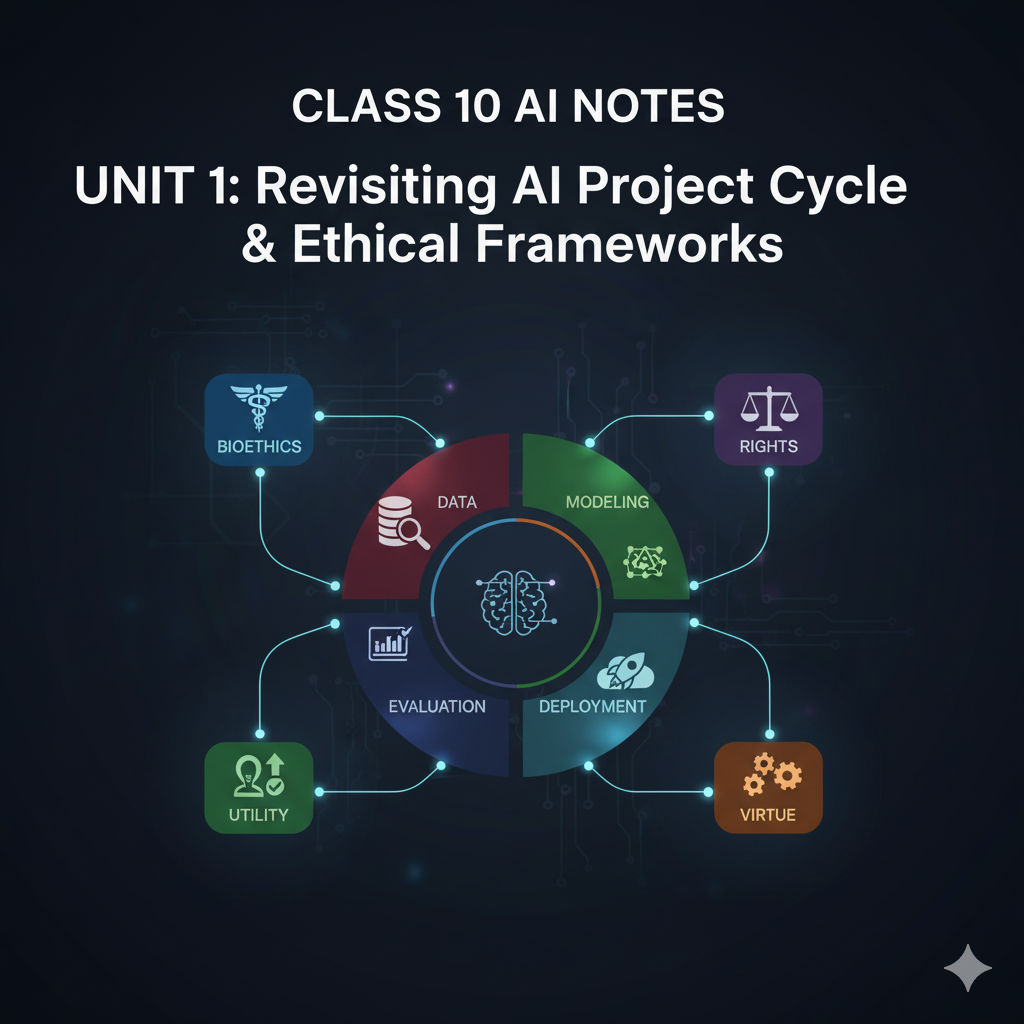
Topics Covered
Reflection Time Questions – NCERT Solutions AI Class 10 Unit 1: Revisiting AI Project Cycle & Ethical Frameworks for AI
1. Outline the main steps in the AI Project Cycle briefly.
Ans.: The main steps of AI Project cycle are:
1. Problem Scoping
2. Data Acquisition
3. Data Exploration
4. Modelling
5. Evaluation
6. Deployment
AI facilitator handbook pg. no. 8
2. What roles does computer vision play in agricultural monitoring systems?
Ans.: Computer Vision play an important role in agricultureal monitoring systems as follows:
Crop health monitoring: Computer vision analyses images of crops to detect stress, nutrient deficiency, or diseases at an early stage.
Pest and disease detection: Image processing helps identify pest infestations and plant diseases by recognizing visual patterns on leaves and stems.
Yield estimation: By analysing crop growth and density from images, computer vision helps predict crop yield accurately.
Use of drones and cameras: Drones equipped with cameras capture high-resolution aerial images of farmland for large-scale monitoring.
Optimizing farming practices: The analysed data helps farmers take timely decisions related to irrigation, fertilization, and pesticide use, improving productivity and reducing cost.
AI facilitator handbook pg. no. 10
3. Mention the factors which knowingly or unknowingly influence our decision-making.
Ans.: Factors that influence our decision-making (knowingly or unknowingly):
Religion: Decisions can be influenced by religious beliefs and whether actions align with personal religious views.
Intuition & Values: Personal values and gut feelings guide whether a decision feels morally or ethically correct.
Value of Humans and Non-Humans: Consideration of how decisions affect humans, animals, and the environment can influence choices.
AI facilitator handbook pg. no. 14
4. What is the necessity for Ethical Frameworks in AI development?
Ans.: Necessity for Ethical Frameworks in AI Development:
Prevent biased outcomes: Ethical frameworks help avoid unwanted biases, such as hiring algorithms discriminating against women.
Ensure morally acceptable decisions: Since AI influences decision-making, frameworks ensure recommendations are ethical and fair.
Avoid unintended consequences: Using ethical principles during development reduces the risk of harmful or unfair outcomes before they occur.
Build trust in AI systems: Ethical AI fosters confidence among users and stakeholders by being transparent and responsible.
AI facilitator handbook pg. no. 13
5. Mention the key characteristics of sector-based frameworks.
Ans.: Key Characteristics of Sector-Based Frameworks:
Industry-specific focus: Tailored to the ethical needs and challenges of a particular sector or industry.
Addresses domain-specific issues: For example, in healthcare, it covers patient privacy, data security, and ethical use of AI in medical decisions.
Applicable across multiple domains: Can be designed for finance, education, transportation, agriculture, governance, and law enforcement.
Guides responsible AI use: Ensures AI systems operate ethically within the rules and norms of the specific sector.
AI facilitator handbook pg. no. 15
6. What do you mean by Bioethics?
Ans.: Bioethics is an ethical framework used in healthcare and life sciences that deals with ethical issues related to health, medicine, and biological sciences, ensuring that AI applications in healthcare follow ethical standards and considerations.
AI facilitator handbook pg. no. 16
7. What is Natural Language Processing? Explain any two real-life applications of NLP.
Ans.: NLP (Natural Language Processing) is a branch of artificial intelligence that focuses on the interaction between computers and humans using natural language. It involves using algorithms to extract information from spoken and written language.
Applications:
1. Spam Filter
2. Machine Translation
AI facilitator handbook pg. no. 11
8. How do value-based frameworks contribute to ethical decision-making by emphasizing fundamental principles and values?
Ans.: Value-based frameworks contribute to ethical decision-making by emphasizing fundamental ethical principles and values. They guide decision-making by assessing the moral worth of actions and promoting ethical behavior based on different moral philosophies.
AI facilitator handbook pg. no. 15
Case-Based Questions – NCERT Solutions AI Class 10 Unit 1: Revisiting AI Project Cycle & Ethical Frameworks for AI
1. Case Scenario:
In a corporate setting, a multinational company is facing scrutiny over its environmental practices, particularly regarding the disposal of industrial waste. The company has historically prioritized profit maximization and cost-cutting measures, leading to practices that result in environmental harm and negative impacts on local communities. As public awareness and concern about environmental sustainability grow, stakeholders, including investors, customers, and advocacy groups, are calling for the company to adopt more responsible and sustainable business practices.
Question:
Drawing from the case presented, analyze the ethical considerations surrounding the company’s environmental practices through the lens of value-based frameworks in ethics.
Ans.:
From a value-based ethics perspective, the company’s focus on profit over environmental protection is unethical because it violates core values like responsibility, fairness, and respect for communities. Ethical decision-making requires assessing the moral worth of actions, emphasizing sustainability and social responsibility. The company has a duty to adopt safe and responsible waste disposal practices and consider the welfare of all stakeholders. Aligning business practices with these fundamental values promotes long-term trust and ethical legitimacy.
2. Case Scenario:
In a rural farming community, a group of small-scale farmers is faced with a dilemma regarding the use of pesticides on their crops. The farmers have traditionally relied on chemical pesticides to control pests and maximize crop yields. However, concerns have been raised about the potential environmental and health impacts of pesticide use, including soil contamination, water pollution, and adverse effects on human health. Additionally, neighboring communities and environmental advocacy groups have expressed opposition to the widespread use of pesticides, citing ecological damage and risks to biodiversity.
Question:
Using the case provided, examine the ethical considerations surrounding pesticide use in the agricultural sector, applying ethical frameworks to analyze the competing interests and values at stake.
Ans.:
From an ethical perspective, the use of pesticides involves balancing farmers’ economic needs with responsibilities toward health and the environment. Value-based ethics emphasizes care, sustainability, and protection of ecosystems. Consequentialist thinking weighs the benefits of higher yields against harms to soil, water, biodiversity, and human health. Duty-based ethics stresses the farmers’ moral obligation to avoid causing harm to others and the environment. Ethically, adopting safer alternatives or sustainable practices ensures both livelihoods and ecological responsibility.
Watch this video to undetstand more: