
Explore Unit 2 Advanced Concepts of Modeling in AI for Class 10. Learn key topics like data modeling, types of models, evaluation methods, and real-world AI applications. Perfect CBSE Class 10 AI notes for exam preparation.
Topics Covered
Unit 2 Advanced Concepts of Modeling in AI
To proceed ahead with Advanced concepts of Modelling in AI, let go through the differecnce between AI, ML and DL.

| Aspect | Artificial Intelligence (AI) | Machine Learning (ML) | Deep Learning (DL) |
|---|---|---|---|
| Definition | The broad field of computer science that focuses on creating machines that can perform tasks requiring human intelligence. | A subset of AI that enables machines to learn from data and improve from experience without being explicitly programmed. | A subset of ML that uses neural networks with many layers to automatically learn complex patterns from large amounts of data. |
| Goal | To create intelligent systems that can think, reason, and act like humans. | To enable systems to learn from data and make predictions or decisions. | To simulate the human brain and automatically extract features for complex tasks like image and speech recognition. |
| Approach | Rule-based systems, logic, search algorithms, and reasoning. | Algorithms that learn patterns from data (e.g., regression, decision trees). | Multi-layered neural networks (e.g., CNNs, RNNs). |
| Data Dependency | Can work with less data (e.g., rule-based AI). | Requires structured and moderate amounts of data. | Needs massive amounts of data and computational power. |
| Human Intervention | Requires human-defined rules and logic. | Requires feature selection and data preprocessing by humans. | Automatically learns features; minimal human intervention. |
| Examples | Expert systems, chatbots, virtual assistants. | Spam detection, recommendation systems, price prediction. | Image recognition, natural language translation, self-driving cars. |
Machine Learning (ML)
Machine Learning (ML) allows systems to get better at tasks through experience. It learns from past errors and uses those lessons to enhance performance in future attempts, continuously improving based on its own experiences.
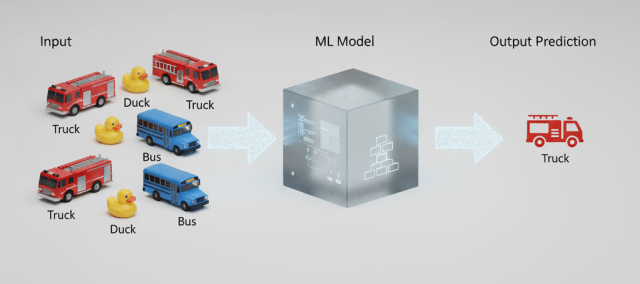
In Machine Learning the past or historical data can be given to machine as input and then the model learns from the given data and then generates the output. Observe the following image:

Let under understand how Machine Learning works. The following image shows labelled images. Every lable is given for the object such as Bus, Truck or Duck. ML model learns from the input data and predict the correct output as displayed in below given image:
Object Classification
Object classification do the following:
- Finds objects in an image or data
- Identifies what each object is
- Labels objects with their correct category

The above image explains object identification using a kitchen example.
- The cupboard in the center represents a smart system (Kitchen Organizer Pro).
- The system detects kitchen items placed inside or around it.
- Each item is identified based on what it is.
- Items are then classified into categories, such as:
- Utensils – spoons, forks, knives, ladles
- Cookware – pots, pans, pressure cookers
- Pantry Staples – jars, spices, food packets
- Similar objects are grouped together under the same label.
- This shows how AI models recognize objects and assign them to the correct class.
The image demonstrates how AI identifies kitchen items and organizes them into proper categories automatically.
Anomaly Detection
- Anomaly detection finds unusual or unexpected patterns in data
- It helps identify values that are different from normal behavior
- For example, a sudden spike in heart rate can be detected, Such anomalies may indicate a potential problem or issue

In the above image,
- Sensor data is continuously collected from a system.
- The system already knows normal patterns from past data.
- A baseline model is learned using these known patterns.
- New data is compared with the baseline model.
- The system identifies deviations from normal behavior.
- If unusual behavior is found, it is marked as an anomaly.
- An alarm is triggered when an anomaly is detected.
- A mobile notification is sent to alert the user.
The image shows how AI detects unusual patterns in data and alerts users when something abnormal occurs.
Deep Learning (DL)
- Deep Learning (DL) allows software to learn and perform tasks using very large amounts of data
- The machine is trained on huge datasets to understand patterns on its own
- It improves its performance by learning from data automatically
- Deep learning systems can create their own algorithms for decision-making
- These systems show a high level of intelligence
- Deep Learning is the most advanced form of Artificial Intelligence among the three
The block diagram below represents the working of Deep Learning:

This image represents the block diagram of an Artificial Neural Network (ANN) used in Deep Learning.
- Input Layer
- The left side shows the input data (numbers, images, text, etc.).
- Each yellow node represents an input feature.
- Hidden Layers
- The middle layers (blue nodes) are called hidden layers.
- They process the input by performing calculations and learning patterns.
- Multiple hidden layers indicate deep learning.
- Connections between nodes show how data flows through the network.
- Weights and Connections
- The lines between nodes represent weights.
- These weights are adjusted during training to improve accuracy.
- Output Layer
- The right side (red nodes) gives the final result.
- It provides predictions or decisions based on the learned data.
The image shows how data flows from input to output through multiple layers of neurons, allowing the system to learn complex patterns and make intelligent decisions.

This image shows how an Artificial Neural Network (ANN) is used for image classification.
The input is an image of an object (a car).
- The image is converted into data and fed into the input layer (yellow nodes).
- The data passes through hidden layers (blue nodes).
- Hidden layers analyze features like shape, edges, and patterns.
- Connections between nodes help the network learn important features.
- The output layer (red nodes) gives the final prediction.
- The system identifies the object as a “Car.”
The image explains how ANN processes an input image through multiple layers and correctly classifies it as a car.
Let’s see few examples of Deep Learning:
Object Identification
- Object identification in deep learning is used to identify objects in an image
- It assigns correct labels to the detected objects
- The system analyzes the image to understand what is present in it
- Powerful algorithms are used to recognize patterns and features
- Based on analysis, objects are categorized into different classes

In the above image,
- The input data consists of images of fruits (apples and oranges).
- These images are given to a deep neural network.
- The network has multiple hidden layers that process the image data.
- Each layer extracts important features like color, shape, and texture.
- Information flows through connected neurons to learn patterns.
- The output layer gives the final result.
- The system classifies the image as either apple or orange.
The image shows how deep learning analyzes input images through several layers and correctly classifies objects into different categories.
Digit Recognition
- Digit recognition is a task in deep learning.
- It helps computers understand handwritten numbers.
- The computer is trained using many images of digits (0 to 9).
- From these images, the computer learns the shapes of numbers.
- After training, it can identify which digit is shown in a new image.
- This is commonly used in applications like reading handwritten forms or PIN numbers.

- he AI is given an image of a digit (example shown: 8).
- The image size is 28 × 28 pixels (Input Layer).
- The Input Layer receives the pixel values of the digit image.
- The Convolutional Layer + ReLU detects important features like edges, curves, and shapes of the digit. ReLU activation removes negative values and improves learning.
- The Pooling Layer reduces the size of the feature map and keeps important information while reducing computation.
- The Second Convolutional Layer + ReLU extracts more detailed and complex features of the digit.
- The Flatten Layer converts the 2D feature maps into a 1D array.
- The Fully Connected Layer analyzes all extracted features. Helps in final decision-making.
- The Output Layer provides probability scores for digits 0 to 9. The highest probability is for digit 8.
- The model predicts the digit as “8” with 99.2% accuracy.
- This diagram explains the step-by-step working of CNN-based handwritten digit recognition, commonly used in AI, machine learning, and image classification.

- The image shows a collection of handwritten digits from 0 to 9.
- Each row represents a single digit (0 in the first row, 1 in the second row, and so on).
- The digits are written in different styles, shapes, and thicknesses.
- This type of image is taken from a dataset like MNIST, commonly used to train AI models.
- It helps the computer learn variations in handwriting.
- Such datasets are used in machine learning and deep learning.
- The AI learns to recognize and classify digits correctly despite different handwriting.
- This is used in real-life applications like bank cheque reading, postal code recognition, and OCR systems.
- This image represents training data used to teach an AI system how to recognize handwritten numbers.
Common terminologies used with data
Data
- Data is raw facts and figures
- It can be represented in tabular form
- Each entity can be represented in form of a single row
- Each entity is described by its features
- Features are the column headers
- Some special features are known as labels
- Labelling is the process of attaching meaning of data
- Features and labels depend on the problem we want to solve.
- For example, if we want to predict house prices, then area, number of rooms, and location are features, while the price of the house is the label.

- Data is of two types:
- Labeled data: Data that includes both input details and the correct output.
- Unlabeled data: Data that includes only input details and no output.

The above image compares labeled data and unlabeled data using simple examples.
Labeled Data (Left & Middle)
- In labeled data, each object has information (labels) attached to it.
- In the first labeled example the objects are clearly named as Airplane and Car.
- In the second labeled example additional details are given airplanes are labeled with number of seats (200 seats, 150 seats).
- This type of data helps the machine to learn by examples.
- Labeled data is mainly used in supervised learning.
Unlabeled Data (Right)
- In unlabeled data, objects are shown without any names or details.
- The machine only sees images of cars and airplanes, but does not know what they are.
- The system must find patterns on its own.
- Unlabeled data is used in unsupervised learning.
By this example we con conclude with this:
- Labeled data = Data with clear answers (name or value).
- Unlabeled data = Data without answers.
Traininig Dataset
- A training data set is a group of examples used to teach an AI model.
- The model studies these examples to understand patterns and learn.
- Just like a teacher explains a topic using many examples, AI also learns from examples.
- In the same way, labeled data is given to the AI model so that it can learn correctly.
Testing Dataset
- A testing data set is used to check how accurate an AI model is.
- It is similar to a class test taken by a teacher to see how well students have understood a topic.
- In testing, the data is first given without showing the labels to the model.
- After the model gives its output, the result is compared with the correct labels to measure accuracy.
Modelling
- AI Modelling involves creating algorithms known as models.
- These models are trained using data to learn patterns.
- Training helps the model generate intelligent outputs.
- It includes writing code to enable machines to learn and make decisions.
- The goal is to make machines behave in an intelligent, human-like manner.
AI Modelling refers to developing algorithms, also called models which can be trained to get intelligent outputs. That is, writing codes to make a machine artificially intelligent.
Types of AI Models
AI model are classified into the following categories:

Rule Based Approach
- Rule-Based Approach is a type of AI modelling where rules are set by the developer.
- The developer clearly defines patterns and conditions in advance.
- The machine does not learn on its own; it only follows given instructions.
- The output depends completely on the rules written by the developer.
- Rule-based chatbots (Scriptbots) are often used on websites.
- They are mainly used to answer FAQs or give basic customer support.
Example:
Scenario – A Bank Website Chatbot for Account Balance Enquiry
- Data:
- The chatbot does not need large training data.
- It works with a fixed set of questions and predefined answers related to banking services.
- Rules:
The chatbot follows clear, rule-based instructions to respond to users.
Rule 1: If the user’s message includes keywords like “check balance,” “account balance,” or “how much money”, move to balance enquiry.
Rule 2: Under balance enquiry:
- Interaction:
- The chatbot checks the user’s message against predefined rules.
- It replies with fixed responses or asks for more information as per the rules.
The rules based approach has following drawback/feature:
- Its learning is static.
- Once the machine is trained, it cannot change or improve on its own.
- It only works correctly for the rules and data given during training.
- If new data or a different situation is given, the machine may fail.
- The machine cannot learn from its mistakes or from feedback.
- It always follows the same fixed rules written by the developer.
- To overcome this problem, Machine Learning is introduced.
- In Machine Learning, the machine can learn from new data.
- It can adjust itself when data or patterns change.
- Unlike rule-based models, machine learning models improve over time.
Learning Based Approach
- The computer learns by seeing examples or by getting feedback.
- The computer learns in a way similar to how humans learn from experience.
- It is not given fixed rules to follow step by step.
- Instead, it studies data to understand patterns.
- Based on these patterns, it learns how to do the task by itself.
- The more data or feedback it gets, the better it can perform.

- The image starts with an unlabelled dataset of dogs.
- Unlabelled means the dogs are not named or categorized (no labels like small, big, breed, etc.).
- This unlabelled data is given to a learning-based AI model.
- The model studies the data on its own without human instructions.
- It looks for patterns and similarities among the dogs.
- Based on what it observes, the AI groups similar dogs together, This process is called clustering.
- In the output, dogs are grouped based on size (small, medium, large).
- The machine decides these groups automatically, not by predefined rules.
- This shows unsupervised learning, where learning happens without labels or answers given in advance.
In short, Learning base approach
- Means the machine learns by itself from data.
- The AI model is trained using given data instead of fixed rules.
- After training, the model can adapt when the data changes.
- If new or different data appears, the model updates its behavior to handle it.
- This helps the system manage new situations and exceptions.
Lets take another example of spam filter.
- A spam filter decides whether an email is spam or not spam.
- It is not programmed with strict rules.
- It is trained using labeled emails (spam and non-spam).
- The model studies patterns like words, sender details, and attachments.
- Based on these patterns, it learns to identify spam emails automatically.
Categories of Machine Learning based models
Machine learning is further divided into three categories:
- Supervised Learning
- Unsupervised Learning
- Reinforcement Learning
Supervised Learning
- In supervised learning, the data given to the machine is labelled.
- Labelled data means each data item has an answer or tag.
- The person training the machine already knows the correct output.
- A label is extra information used to identify or classify data.
- Labels help the machine learn what the correct result should be.
Example:
- Students write exams and get marks.
- Based on marks, they receive grades (A, B, C, etc.).
- These grades act as labels to categorize students.
Similarly, in supervised learning, the machine learns by comparing input data with labels.
Observe these two images and understand more:
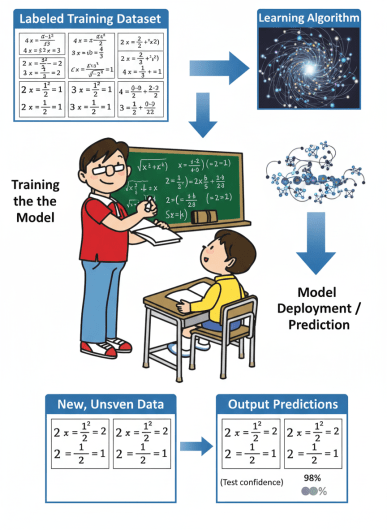

In a corporate environment, Supervised Learning can be applied to categorize employees based on their professional experience and performance.
Example: Employee Career Level Prediction
In this scenario, a company wants to build a model that automatically predicts an employee’s Job Level based on their Years of Experience.
- Dataset: Historical records of current and past employees including their experience and corresponding titles.
- Training Data: The model is “taught” using specific pairs:
- 2 years of experience -> Junior Associate
- 5 years of experience -> Senior Associate
- 10 years of experience -> Manager
- 15 years of experience-> Director
- Feature (Input): Years of Experience.
- Label (Target Output): Job Level (Junior, Senior, Manager, etc.).
How the Process Works
- Training Phase: Just like a teacher uses solved math problems to train students, the HR system uses known data (Years of Experience + Job Level) to train the Supervised Learning Model.
- Prediction Phase: Once trained, when a new employee’s data is entered (e.g., 6 years of experience), the model “predicts” or labels them as a Senior Associate based on the patterns it learned during training.

Sub-categories of Supervised Learning Model

Classification Model
- In this approach, data is classified based on predefined labels.
- Each data item is assigned to a specific category or class.
- For example, in a grading system, students are categorized according to the grades they obtain based on their examination marks.
- This model works with a discrete dataset, meaning the data values are separate and distinct.
- The data does not need to be continuous in nature.
Example

- In a classification model, data is divided into predefined classes or labels.
- In this example, customers are classified into two classes:
- Low-Engagement Customers
- High-Engagement Customers
Input Features (Independent Variables)
- The classification model uses the following features:
- Website Visit Duration (minutes)
- Purchases per Month
- These features are numeric and help the model learn customer behavior.
Labeled Training Data
- Each data point (customer) in the diagram already has a label:
- Purple dots → Low-Engagement
- Green dots → High-Engagement
- Since labels are available, this is a supervised learning problem.
Decision Boundary
- The black diagonal line represents the decision boundary created by the classification model.
- It separates the feature space into two regions:
- One region for Low-Engagement customers
- Another region for High-Engagement customers
- Models such as Logistic Regression, SVM, or Decision Trees can generate such boundaries.
Classification Process
- When a new customer visits the website:
- Their visit duration and purchase frequency are given to the model.
- The model checks which side of the decision boundary the data point lies on.
- The customer is then classified into the appropriate class.
Model Output
- The output of the classification model is a discrete class label, not a continuous value.
- Example outputs:
- “Low-Engagement Customer”
- “High-Engagement Customer”
Importance of Classification in Business
- Helps identify valuable customers.
- Enables targeted marketing and personalized offers.
- Improves customer retention and sales strategy.
Key Conclusion
- This diagram demonstrates how a classification model uses labeled data and decision boundaries to categorize customers into predefined classes based on their behavior.
Regression Model
- Regression models work on continuous data.
- They use past numerical data to make predictions.
- The output is a numerical value, not a category.
- Salary prediction is a common example.
- Temperature, price, income, and age are continuous values.

- This is an example of a Regression Model.
- It works on continuous data.
- Used to predict numerical values (not categories).
- Common real-life use: sales prediction, price prediction, demand forecasting.
Examples Regression Model:
- Temperature Predictions

2. House prediction

3. Car price prediction

Unsupervised Learning
- In unsupervised learning, the machine is given unlabelled data.
- Unlabelled data means there are no names, tags, or answers provided.
- The data may look random, and even the person training the model may not know much about it.
- The machine learns by itself without any guidance.
- It looks for patterns, similarities, and relationships in the data.
- The model groups or organizes data based on these patterns.
- This helps users understand the data better.
- It also shows the important features and trends found by the machine.
Observe this image and look at the given explanation:

The input to the system is 1000 dog images.
- These images are unlabelled, meaning no names, sizes, or types are given.
- All images are fed into an unsupervised learning model.
- The model does not know anything in advance about the dogs.
- It analyzes the images on its own.
- The machine looks for similarities and differences between dogs.
- Based on these similarities, it discovers patterns.
- The model groups dogs based on:
- Color (light, dark, mixed)
- Size (small, medium, large)
- Ear and tail type (shape and style)
- These groupings are done automatically by the machine, not by humans.
- This helps users understand the hidden patterns in the data.
Supervised Learning vs Unsupervised Learning
| Supervised Learning | Unsupervised Learning |
|---|---|
| Deals with labelled data | Deals with unlabelled data |
| Useful in real-world problems like predicting prices based on past trends | Useful for finding unknown patterns in large datasets |
| Uses known inputs and outputs during training | Uses only input data, no known outputs |
| Requires less computing power because clean, labelled data is used | Requires more computing power due to unorganized and messy data |
| The model is guided during learning | The model learns on its own |
Sub categories of Unsupervised Learning
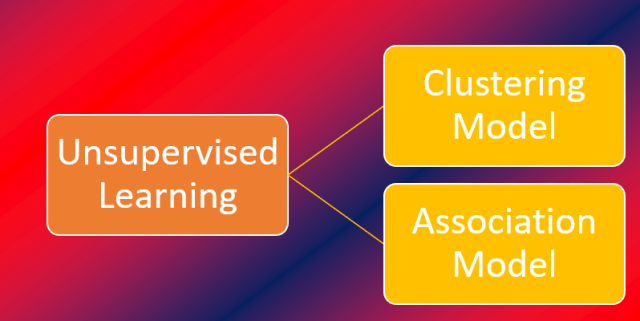
Unsupervised learning models can be further divided into two categories:
- Clustering model
- Association model
Clustering

Step-by-step explanation of the image:
- Raw Data (Left side)
- The left circle shows raw, unlabelled data.
- Different shapes and colors (blue circles, green squares, yellow triangles) represent data points.
- At this stage, the computer does not know which data belongs to which group.
- Unsupervised Learning Model – Clustering (Middle)
- The middle box represents a clustering algorithm (unsupervised learning).
- “Unsupervised” means:
- No predefined labels
- The model finds patterns on its own
- The algorithm analyzes similarity (shape, color, distance, features) among data points.
- Clusters (Right side)
- The data is divided into groups (clusters) based on similarity.
- Example shown:
- One cluster has only blue circles
- Another cluster has green squares and yellow triangles
- Each cluster contains data points that are more similar to each other than to points in other clusters.
Key idea shown by the image:
Clustering groups similar data points together without any prior labels.
Simple definition (for exams):
Clustering is a process of dividing data into groups such that data points in the same group are similar to each other.
Real-life examples:
- Grouping students based on performance
- Customer segmentation in marketing
- Image grouping in Google Photos
Difference between Clustering and Classification
- Classification uses already defined categories, and objects are placed into these fixed classes.
- Clustering groups objects by finding similarities among them, putting similar ones together and separating them from different ones.
Association Model
Association Rule is an unsupervised learning technique used to discover useful relationships or patterns between different items in a database.
Reinforcement Learning
- The computer learns by making decisions on its own.
- It performs actions and observes the results.
- The system receives a reward or penalty based on its actions.
- The goal is to maximize the reward over time.
- No human guidance is needed during learning.
- The computer is not explicitly programmed with rules to complete the task.
- It improves its performance by learning from experience.

The image showing Reinforcement Learning:
- The input given to the system is a dog image.
- This image is sent to a Reinforcement Learning agent.
- The agent tries to identify the image by making guesses.
Trial and Feedback Process:
- Trial 1: The agent predicts Cat → Incorrect → Negative reward
- Trial 2: The agent predicts Wolf → Incorrect → Negative reward
- Trial 3: The agent predicts Fox → Incorrect → Negative reward
- Trial 4: The agent predicts Dog → Correct → Positive reward
- After each prediction, the agent receives feedback (reward or penalty).
- The agent learns from mistakes by avoiding wrong answers.
- It repeats correct actions to gain positive rewards.
- Over time, the agent improves its decision-making.
- Finally, the agent learns the correct identity: “DOG”.